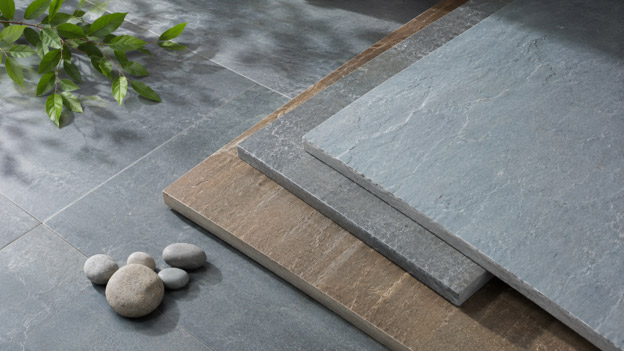
Kota Limestone is a natural limestone widely used for flooring, paving, wall applications and other architectural purposes. It is quarried mainly around the Kota region of Rajasthan, particularly the Ramganj Mandi belt, and is known for its natural colours, practical durability and suitability for both residential and commercial projects. Its availability in different shades, sizes and finishes makes it a versatile natural flooring stone.
What Is Kota Limestone?
Kota Limestone is a fine-grained natural limestone quarried in the Kota region of Rajasthan, India. It is commonly processed into slabs, tiles and flooring pieces for use in homes, offices, commercial buildings, pathways and outdoor areas. Unlike manufactured flooring products, every piece has naturally occurring variations in colour, texture and pattern.
Limestone is a recognised building stone used for slabs and tiles, including flooring applications. The Bureau of Indian Standards lists IS 1128 for limestone slabs and tiles, while other Indian Standards cover testing and characteristics of natural building stones.
Where Does Kota Limestone Come From?
The name "Kota Limestone" comes from the Kota region of Rajasthan, with Ramganj Mandi being one of the most important centres associated with its quarrying, processing and supply.
The stone is extracted from natural deposits and then cut, calibrated and finished according to the intended application. This regional availability has made Kota an important sourcing destination for buyers looking for natural limestone and Kota stone flooring.
For large projects, sourcing closer to the production area can also simplify material inspection, custom sizing and bulk procurement compared with buying through multiple layers of distribution.
Key Characteristics of Kota Limestone
One of the main reasons buyers consider Kota Limestone is its combination of natural appearance and practical performance.
Important characteristics include:
- Natural limestone composition
- Fine and relatively uniform grain in suitable grades
- Naturally occurring colour variations
- Availability in different thicknesses and sizes
- Suitable for both indoor and outdoor applications when the correct finish is selected
- Can be processed into different surface finishes
- Suitable for large flooring projects as well as residential applications
- Requires routine cleaning rather than complicated maintenance
Natural stone should always be evaluated according to its intended application. A stone that works well for an interior floor may require a different finish or specification when used in an outdoor, wet or high-traffic environment.
Types and Colour Variations of Kota Limestone
Kota Limestone is commercially available in several colours and visual variations. The exact appearance can vary between quarry blocks, production batches and finishes.
Kota Blue Limestone
Kota Blue is one of the most recognisable varieties. It generally has a blue-grey to greyish appearance and can create a clean, understated look in contemporary and traditional architecture.
It is commonly considered for:
- Residential flooring
- Office flooring
- Commercial interiors
- Walkways
- Outdoor paving
- Institutional projects
- Feature flooring
When buying Kota Blue, don't judge quality only by the word "blue." Shade consistency, thickness, surface finish, edge quality and the amount of natural variation should also be checked.
Kota Brown Limestone
Kota Brown offers a warmer, earthy appearance than blue-grey varieties. Its natural character can work well where the design requires a more traditional or rustic visual effect.
It can be considered for:
- Outdoor flooring
- Courtyards
- Pathways
- Residential areas
- Commercial landscaping
- Interior spaces requiring warmer natural tones
Other Natural Variations
Depending on quarry availability and processing, Kota stone may also be supplied in greyish, greenish or other naturally occurring tones. Buyers should request actual samples from the current production batch because natural stone colour can vary from one lot to another.
Common Sizes, Thicknesses and Finishes
Kota Limestone is not limited to one standard format. It can be supplied as flooring pieces, tiles or slabs depending on project requirements.
Common commercial requirements may include different combinations of:
- Square tiles
- Rectangular tiles
- Custom-cut pieces
- Larger slabs
- Standard flooring formats
- Different thicknesses for different applications
Thickness is particularly important. Residential flooring and heavy-duty areas do not necessarily have the same requirements. The final specification should consider the expected traffic, substrate, installation method and intended use.
Surface finish also changes both appearance and performance.
Common finishes include:
Natural or rough finish:
A more textured surface that can be useful where grip and a natural appearance are important.
Honed or semi-polished finish:
Provides a smoother appearance without necessarily creating the highly reflective surface associated with high-gloss polishing.
Polished finish:
Creates a smoother and more reflective appearance and is generally selected for applications where aesthetics are a priority.
Shot-blast finish:
Creates a textured surface and can be considered for applications where slip resistance and outdoor performance are important.
The correct finish should be selected based on the environment rather than appearance alone.
Where Is Kota Limestone Used?
Kota Limestone has applications across residential, commercial and institutional construction.
Residential Applications
Homeowners commonly consider natural limestone for:
- Living room flooring
- Bedrooms
- Corridors
- Balconies
- Courtyards
- Verandas
- Stair areas
- Outdoor pathways
For interiors, buyers often prioritise colour consistency, smoothness and finish. For exterior areas, drainage, surface texture and slip resistance become more important.
Commercial Applications
Commercial projects may use Kota Limestone for:
- Offices
- Hotels
- Schools
- Institutional buildings
- Shops
- Restaurants
- Warehouses
- Public spaces
- Walkways and landscaping
For high-footfall applications, the purchasing decision should focus on more than appearance. Thickness, wear characteristics, finish and installation quality can have a major effect on long-term performance.
Indoor vs Outdoor Kota Limestone
Kota Limestone can be considered for both indoor and outdoor applications, but the specification should change according to the environment.
| Factor | Indoor Application | Outdoor Application |
|---|---|---|
| Surface | Smooth finishes may be preferred | Textured or suitable anti-slip finishes may be preferable |
| Appearance | Colour consistency is often important | Natural variation can work well |
| Water exposure | Usually lower | Rain and moisture must be considered |
| Traffic | Residential or commercial traffic | Foot traffic, weather and environmental exposure |
| Maintenance | Regular sweeping and cleaning | Cleaning may need to account for dirt, algae or weathering |
| Installation | Level substrate is important | Drainage and slope are particularly important |
For wet locations, entrances, poolside areas or exposed pathways, buyers should discuss the appropriate finish with the supplier and installer instead of selecting a finish solely on visual appeal.
Benefits of Kota Limestone
1. Natural Appearance
Natural limestone provides variations that are difficult to reproduce with printed or manufactured flooring products.
2. Versatile Design
Different colours, formats and finishes allow the material to work with traditional, modern and commercial designs.
3. Suitable for Large Projects
Kota stone is widely considered for projects requiring substantial quantities of natural flooring material.
4. Practical Maintenance
Routine cleaning and appropriate care can help preserve the appearance of properly installed limestone flooring.
5. Multiple Finishing Options
The stone can be processed into different surface finishes depending on the intended application.
6. Local Availability
The Kota and Ramganj Mandi region provides buyers with access to an established natural stone supply chain.
Limitations Buyers Should Know
Kota Limestone is not maintenance-free, and natural stone should not be treated like a completely uniform manufactured tile.
Potential considerations include:
- Natural variation between pieces
- Shade differences between batches
- Surface variation
- Possible staining if inappropriate materials or cleaning methods are used
- Need for proper installation
- Different performance depending on finish and application
- Need for appropriate care in wet or exposed environments
These are not necessarily disadvantages; they are normal considerations when purchasing natural stone.
Kota Limestone Price: What Actually Determines the Cost?
There is no single Kota Limestone price that applies to every project.
The final quotation can vary according to:
- Stone colour and grade
- Thickness
- Tile or slab size
- Surface finish
- Cutting and calibration requirements
- Quantity ordered
- Sorting and shade selection
- Packaging
- Loading
- Transportation distance
- GST and applicable charges
- Installation requirements
The website's existing price information also demonstrates that rates can differ according to size and thickness, which is why buyers should compare quotations using the same specification rather than comparing only the per-square-foot figure.
What Affects Kota Blue Limestone Price?
When researching "kota blue limestone price", buyers should look beyond the colour name.
The price of Kota Blue can be influenced by:
- Shade consistency – More consistent material may command a different price than heavily varied batches.
- Thickness – Thicker stone generally requires more raw material.
- Size – Larger or custom-cut pieces may involve additional processing.
- Finish – Polishing, honing, shot blasting or other processing affects production cost.
- Quality and sorting – Better-selected material can cost more than mixed-grade stone.
- Order quantity – Bulk project orders may receive different commercial quotations.
- Transportation – Freight can significantly affect delivered cost outside the Kota region.
- Packaging and handling – Larger or more carefully packed consignments can have additional costs.
Therefore, when comparing the kota blue limestone price from two suppliers, ask both suppliers to quote the same colour, size, thickness, finish, quantity and delivery location.
How to Check Kota Limestone Quality Before Buying
A sample inspection is one of the most useful steps before placing a large order.
Check the following:
- Thickness consistency
- Flatness of pieces
- Edge quality
- Surface finish
- Visible cracks or unwanted defects
- Shade consistency within the batch
- Excessive pits or weak areas
- Size accuracy
- Packaging quality
- Whether the supplied sample matches the production batch
For a large commercial order, ask for a representative sample or sample batch rather than making the entire decision from photographs.
If technical performance is critical, buyers should also ask whether appropriate test data is available for the stone and application. BIS maintains standards covering limestone slabs and tiles as well as methods related to natural building stone durability and other properties.
How to Choose a Reliable Kota Limestone Supplier
Choosing the right supplier can be as important as choosing the stone.
A reliable natural stone supplier should be able to clearly explain:
- Available colours and grades
- Size and thickness options
- Finish options
- Minimum order requirements
- Production lead time
- Packaging method
- Transportation arrangements
- Replacement or damage policy
- Payment terms
- Whether the quoted price includes freight and taxes
For large orders, ask for a written quotation containing the complete material specification.
Supplier vs Dealer: Which Is Better?
Buying directly from a manufacturer or processor can be useful for large project orders because buyers may have more control over specifications, production and bulk quantities.
A local dealer can be more convenient for smaller purchases and may provide easier local delivery or installation coordination.
The better option depends on project size, location, required quantity and the level of customisation needed.
The important point is to compare the total delivered value, not simply the material rate.
Bulk and Project-Order Considerations
For a large flooring project, don't order the complete quantity immediately based only on an online photograph.
A better process is:
- Confirm the required area.
- Select colour and finish.
- Approve a physical sample.
- Finalise size and thickness.
- Confirm wastage requirements.
- Obtain a written quotation.
- Confirm delivery schedule.
- Check packaging and unloading arrangements.
- Approve the production batch where practical.
- Keep replacement material for future repairs if appropriate.
For natural stone, ordering from one consistent production batch can help reduce visible variation across a large installation.
Installation Tips for Kota Limestone
Good-quality stone can still perform poorly if installation is not done correctly.
Before installation:
- Ensure the substrate is properly prepared.
- Confirm the required slope in outdoor areas.
- Use an appropriate fixing system and bedding material.
- Maintain consistent joints.
- Check pieces before laying.
- Avoid mixing significantly different batches without planning.
- Clean excess installation material promptly.
- Allow the flooring to cure properly before heavy use.
Outdoor applications deserve particular attention to drainage. Standing water can create maintenance problems regardless of how attractive the stone looks.
Kota Limestone Maintenance
Routine maintenance is generally straightforward.
For everyday care:
- Sweep or dust the floor regularly.
- Clean with a suitable stone-safe cleaning solution.
- Remove spills promptly.
- Avoid harsh acidic cleaners unless specifically recommended for the stone.
- Do not use abrasive cleaning methods unnecessarily.
- Keep outdoor surfaces free from accumulated dirt and organic growth.
- Follow the supplier or stone-care professional's recommendations for sealing, if applicable.
Always test a new cleaning product on a small inconspicuous area before applying it across the entire floor.
Common Kota Limestone Buying Mistakes
Choosing Only by Price
The cheapest quotation may not represent the best value if the material has inconsistent thickness, poor sorting or unsuitable finishing.
Comparing Different Specifications
A 20 mm natural-finish stone should not be directly compared with a thicker polished stone simply because both are quoted per square foot.
Ordering Without a Sample
Photographs can make natural stone appear more uniform than it actually is.
Ignoring Transportation
A low ex-factory rate can become expensive after freight, loading and unloading costs are added.
Selecting the Wrong Finish
A finish suitable for an interior may not be the right choice for a wet outdoor area.
Not Confirming Quantity
For cutting and installation, some wastage should be anticipated. The exact allowance depends on layout, room geometry and stone format.
Final Kota Limestone Buyer Checklist
Before confirming your order, make sure you have checked:
- Colour and grade
- Size
- Thickness
- Finish
- Sample approval
- Quantity
- Expected wastage
- Material price
- GST and additional charges
- Transportation cost
- Packaging
- Delivery timeline
- Quality inspection process
- Installation requirements
- Cleaning and maintenance requirements
Frequently Asked Questions About Kota Limestone
1. Is Kota Limestone good for flooring?
Yes, Kota Limestone is widely used for natural stone flooring. Its suitability depends on the selected grade, thickness, finish, installation method and the environment where it will be installed.
2. Is Kota Limestone the same as Kota Stone?
The terms are often used interchangeably in the flooring market because Kota Stone is a limestone used extensively as a building and flooring stone. However, buyers should confirm the exact commercial specification, colour, thickness and finish being offered.
3. What is Kota Blue Limestone?
Kota Blue is a blue-grey natural limestone variety associated with the Kota stone industry. It is used for flooring, paving and architectural applications where its understated natural colour is desired.
4. What is the kota blue limestone price?
There is no universal price. Kota Blue pricing depends on thickness, size, finish, quality, quantity, processing and delivery location. Always request a quotation based on an identical specification when comparing suppliers.
5. Is Kota Limestone suitable for outdoor flooring?
It can be suitable for outdoor applications when the appropriate stone specification and surface finish are selected. Drainage, surface texture and installation quality are especially important outdoors.
6. Does Kota Limestone require maintenance?
Yes. Like other natural stone flooring, it benefits from regular cleaning and appropriate care. The maintenance requirement depends on the finish, location and amount of traffic.
7. Can Kota Limestone be polished?
Certain limestone products can be mechanically processed and polished, although the achievable appearance depends on the stone's characteristics and the selected processing method. Buyers should inspect a finished sample before placing a large order.
8. What thickness should I choose for Kota Limestone flooring?
There is no single thickness that is correct for every project. The choice should consider traffic, installation method, substrate and application. Residential, commercial and heavy-duty areas may require different specifications.
9. Should I buy Kota Limestone directly from a manufacturer?
For bulk and project orders, purchasing closer to the manufacturing or processing source can offer advantages in terms of specification control and bulk procurement. For smaller orders, a local dealer may provide convenience. Compare the complete delivered quotation before deciding.
10. How can I check Kota Limestone quality?
Inspect a representative sample for thickness consistency, flatness, edges, finish, cracks, unwanted defects and shade consistency. For technically demanding projects, ask for relevant test information where available.
Conclusion
Kota Limestone remains a practical natural stone option for buyers who want a combination of natural appearance, flexible design options and suitability for a wide range of flooring and architectural applications.
The best purchase is not necessarily the stone with the lowest quoted rate. Buyers should compare colour, grade, thickness, size, finish, quality, transportation and installation requirements together. This becomes particularly important when comparing the kota blue limestone price from different suppliers.
Whether you are selecting flooring for a home, planning a commercial project or purchasing stone in bulk, start with a representative sample and a detailed specification. Once the material is approved, compare suppliers on quality, consistency, delivery capability and total project cost rather than price alone.


